
Every year, Missouri roads carry millions of drivers between communities like Columbia, Jefferson City, and Moberly.
While most speeding tickets, such as those issued for traveling 10 miles over the limit on Highway 63 or Interstate 70, are treated as routine traffic matters, some situations escalate into serious legal crises.
Knowing what felony speeding in Missouri is is vital, and the answer is more nuanced than a simple miles-per-hour threshold.
Missouri law does not set a specific speed that automatically triggers a felony. Instead, it is the combination of excessive speed and aggravating circumstances that transforms an ordinary traffic stop into a life-altering criminal or civil matter.
For those seriously injured in high-speed collisions, this distinction is critical. A crash involving extreme speed raises immediate questions about criminal accountability and civil liability.
Missouri Speeding Classifications: The Baseline
Before understanding how speeding becomes a felony, it is helpful to review the standard classifications under Missouri law:
- Infractions: Under RSMo Section 304.009, exceeding the limit by five miles per hour or less is an infraction (the least serious classification).
- Class C Misdemeanors: Under RSMo Section 304.010, driving six to 19 miles per hour over the limit can generally fall into this category.
- Class B Misdemeanors: Under RSMo Section 304.010, exceeding the limit by 20 or more miles per hour is a Class B misdemeanor, punishable by up to six months in jail and a $1,000 fine.
On its own, speeding is rarely a felony. The legal picture changes when aggravating factors are present.
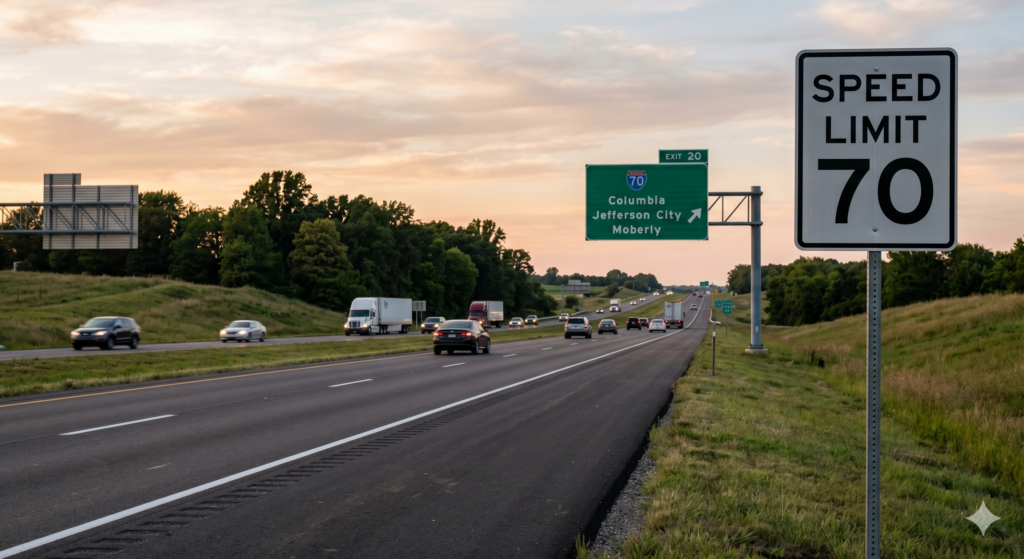
A “Speed Limit 70” sign on a Missouri highway near Columbia and Jefferson City, illustrating the legal thresholds for felony speeding charges and civil liability in MO.
Factors That May Elevate Speeding to a Felony
Prosecutors typically look for specific circumstances to justify felony-level charges following a high-speed incident:
1. Resulting Physical Injury or Death
This is the most significant path to a felony. Missouri does not have a standalone vehicular manslaughter statute; instead, prosecutors use general involuntary manslaughter laws.
Under RSMo Section 565.024, recklessly causing the death of another person constitutes first-degree involuntary manslaughter, a Class C felony punishable by three to ten years in prison.
2. Resisting Arrest or Fleeing
High-speed pursuits are treated with extreme seriousness.
Under RSMo Section 575.151, fleeing or attempting to elude law enforcement after a signal to stop can be charged as a felony – if the flight involves reckless driving that creates a substantial risk of serious physical injury.
3. Endangerment of a Minor
Operating a vehicle at dangerous speeds with a child passenger can trigger child endangerment statutes.
Depending on the risk posed, these charges can elevate the seriousness of the legal proceedings significantly.
For those seeking information on defending against these citations, our overview of traffic violation defense provides further context.
The Connection Between Speed and Civil Liability
Criminal charges and civil injury claims operate in separate systems, but they often overlap.
In Missouri civil courts, the concept of negligence per se may apply.
If a driver violates a safety statute (like speeding) and causes the exact type of harm the law was designed to prevent, that violation can be used as evidence of negligence.
Impact on Injury Severity
The physics of speed are unforgiving. According to the National Highway Traffic Safety Administration (NHTSA), speeding was a contributing factor in 29% of all traffic fatalities in 2024.
High-speed collisions are exponentially more likely to cause:
- Traumatic brain injuries (TBI)
- Spinal cord injuries and paralysis
- Internal organ damage
In Missouri, “pain and suffering” damages are subjective.
However, the Missouri Supreme Court ruled in Faught v. Washam that attorneys cannot use the “per diem” method (assigning a dollar value to each day of suffering) during trial, as it encourages speculation rather than individualized judgment.
Seeking Accountability: Evidence and Punitive Damages
In cases involving high speed, evidence must be gathered quickly. This can include Event Data Recorders (EDRs) or “black boxes,” surveillance footage, witness statements, and accident reconstruction analysis.
If a driver’s conduct was particularly reckless, RSMo Section 510.261 allows for punitive damages. These are intended to punish the defendant rather than just compensate the victim. To qualify, a plaintiff must prove by “clear and convincing evidence” that the defendant acted with a deliberate and flagrant disregard for safety.
Finally, families should be aware of RSMo Section 537.020 regarding survival actions. If a victim passes away before a claim is resolved, an estate must typically be opened within one year of death to preserve the claim.
Professional Guidance for Missouri Accident Victims
Evidence like skid marks and electronic data disappears quickly after a crash. For families throughout Boone County and Mid-Missouri, waiting to understand your options can be a costly mistake.
If you or a loved one is dealing with the aftermath of a high-speed collision, our Columbia car accident lawyers are here to help you navigate the road to recovery.
Contact Harper, Evans, Hilbrenner & Netemeyer today for a no-obligation consultation. We handle personal injury cases on a contingency basis, ensuring you have access to experienced advocacy when you need it most.
Legal Disclaimer: This content is provided for general informational purposes only and does not constitute legal advice or the formation of an attorney-client relationship. Missouri law is complex and fact-specific; statutory ranges and procedural rules may vary based on your unique situation. If you have questions about a specific matter, please consult a licensed Missouri attorney directly.